
Journal prompts for anxiety
35 Journal Prompts for Anxiety
35 journal prompts for writing about worries, checking assumptions, and noticing your surroundings. Choose a question and write by hand in your journal.
Updated October 14, 2026
Key takeaways
- A specific question can give you somewhere to start when a blank page feels difficult.
- 35 prompts organized into five types: worry audit, thought challenge, grounding, perspective shift, and self-compassion.
- Write by hand in your own paper journal. Journal Party delivers the prompts, timer, and ambient audio.
- For structured programs, Journal Party Premium includes anxiety-specific guided sessions.
What the research says about journaling for anxiety
A 2022 review by Sohal and colleagues found benefits from journaling in some mental health studies, but the results varied substantially. The review does not establish that the prompts on this page work better than free-writing.
Use these questions as starting points for reflection. You do not have to finish a prompt, write every day, or keep going if it makes you feel worse.
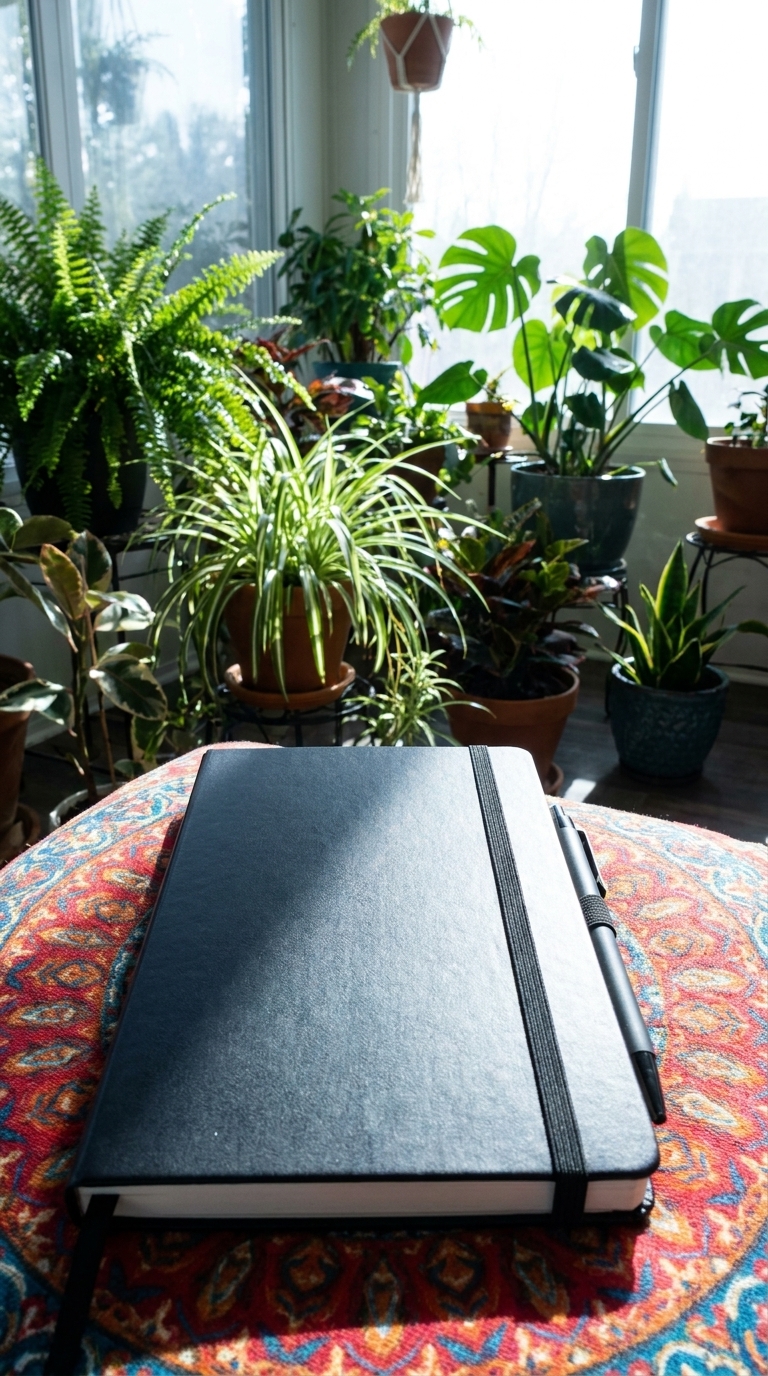
Use a question when you are not sure where to start
If choosing a topic feels difficult, try a question about one worry or one thing you can notice around you.
The groups below offer different starting points. Choose whichever feels manageable today, and skip questions you do not want to answer.
Worry audit prompts (7)
Use these when the anxiety is vague or feels too big to hold. The goal is to name the worry precisely and separate what is actually happening from what you are imagining.
- What specifically am I worried about right now, as concrete as possible?
- Is this worry about something happening right now, or something that might happen?
- What is the most likely realistic outcome here, not the worst case?
- What is the smallest piece of this worry I could address today?
- What would I tell a close friend who came to me with this exact worry?
- Is this something I can influence, or is it outside my control?
- Have I been in a situation that felt this uncertain before? What actually happened?
Thought challenge prompts (7)
Based on cognitive behavioral therapy (CBT) techniques. These prompts ask you to examine the evidence behind anxious thoughts rather than accept them as facts.
- What evidence supports this thought? What evidence contradicts it?
- Am I predicting the future as if it is already fact?
- What is one thing I know to be true right now?
- What is the kindest thing I could tell myself at this moment?
- Is there a version of this situation where things turn out okay?
- Am I assuming I know what someone else thinks or intends?
- What do I know for certain vs. what am I fearfully assuming?
Grounding prompts (7)
Use these when anxiety has moved into your body and you need to return to the present moment. These prompts work best written slowly, with full attention on what is immediately real.
- What is happening in my body right now? Where do I feel the anxiety physically?
- What are three things I can see in front of me right now?
- What helped me feel calm at any point today, even briefly?
- Describe my immediate surroundings in detail: what I see, hear, and smell.
- What have I already handled today that I was not sure I could?
- What does my body need right now: rest, movement, food, or water?
- What time is it? What is happening around me at this moment?
Perspective shift prompts (7)
Use these when you are stuck in a narrow frame around a problem. These prompts widen the view without dismissing what you are feeling.
- In five years, how much will this specific worry matter?
- What is one thing going right that I have not fully acknowledged today?
- Who in my life handles similar challenges well? What would they do?
- What does this situation have to teach me?
- What was I equally anxious about last month that has since resolved?
- What is one thing I am genuinely proud of from this week?
- What is anxiety protecting me from having to feel or face right now?
Self-compassion and closure prompts (7)
Use these at the end of a session or at the end of a hard day. The goal is not to solve anything, but to close the loop gently and give yourself permission to set the worry down.
- What do I need to let go of today, not permanently, but just for tonight?
- What am I carrying that actually belongs to someone else?
- What would it feel like to trust myself with this?
- What is one small act of care I could do for myself today?
- What is one concrete next step, even if it is just a five-minute task?
- What would "good enough" look like here?
- What do I want to remember about how I showed up today?
How to use these prompts
Choose one prompt and give yourself a few minutes to write by hand. You can stop before the timer ends. You do not need to edit or finish the entry.
Journal Party Premium includes structured anxiety programs with these types of prompts already sequenced and paced with built-in timers and ambient audio. You write by hand in your own journal. Nothing you write goes into the app.
A note on severity: journaling is a self-reflection tool, not a substitute for professional care. If anxiety is significantly disrupting your daily life, please speak with a licensed mental health professional.
Frequently asked questions
Does journaling actually help with anxiety?
Journaling may help some people, but the results vary. The 2022 review by Sohal and colleagues found promising results across different writing exercises, with substantial differences between studies. It did not test these prompts or show that prompts always work better than free-writing.
How often should I journal for anxiety?
Choose a schedule that feels manageable. You could start with a few minutes once or twice this week, then decide whether you want to continue. There is no requirement to write daily.
Should I journal when anxious or when calm?
Choose a time when writing feels manageable. You might write about a worry while it is on your mind or come back to it later. If writing intensifies your distress, stop and seek support.
What type of journaling is best for anxiety?
There is no single format that works best for everyone. You could describe what you are worried about, examine an assumption, or write about your surroundings. If you are working with a therapist, ask what kind of writing fits your care.
Can journaling replace therapy for anxiety?
No. Journaling is a self-reflection tool, not a clinical intervention. It can complement therapy by building self-awareness between sessions, but it is not a substitute for professional care. If anxiety is significantly disrupting your daily life, please speak with a licensed mental health professional.
Is Journal Party good for anxiety journaling?
Journal Party includes programs specifically for anxiety. Sessions include prompts, a built-in timer, and optional ambient audio. You write by hand in your own paper journal. Journal Party supports reflection and habit-building. It is not therapy or a substitute for professional care. In crisis? Call or text 988 (US) or visit findahelpline.com.
Ready to put this into practice with more structure? Premium unlocks a growing library with new programs every week, and PowerPrompt sessions with optional audio. Annual Premium is $97/year after a 14-day free trial.
See Annual Premium